Dedicated and
Passionate Law Firm
Providing Aggressive
Representation
Passionate Law Firm
Providing Aggressive
Representation




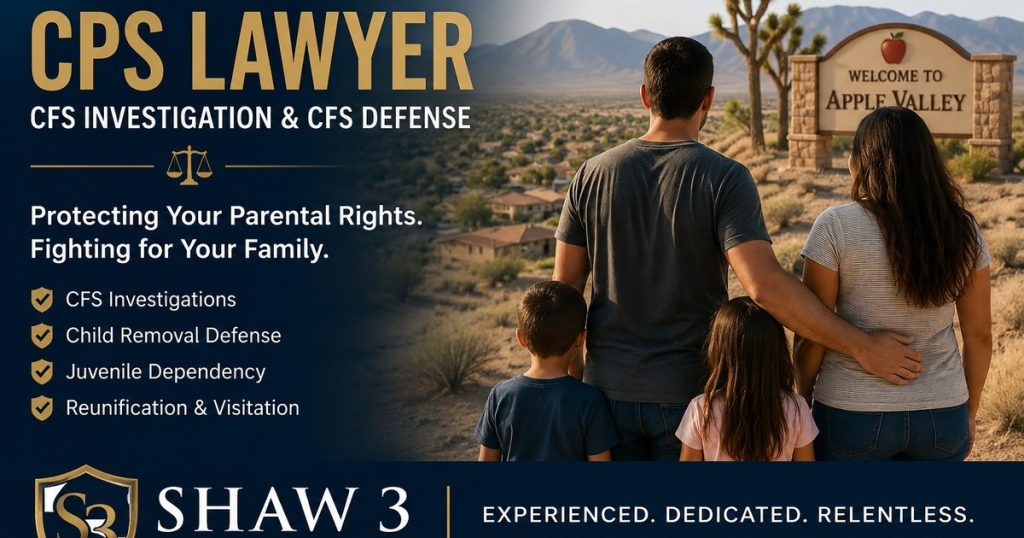
A CPS investigation can begin with a phone call, an unexpected visit, an interview with your child, or allegations that you abused or neglected your child. A Apple Valley CPS Lawyer | CFS Investigation & CFS Defense can help understand the process.
What starts as an investigation can quickly become a San Bernardino County Juvenile Dependency Court case.
Shaw 3 Law Firm represents Apple Valley parents facing Children and Family Services (CFS) investigations, child removal, and juvenile dependency proceedings.
Our goal is straightforward: protect your parental rights, challenge unsupported allegations, and fight to keep or return your children home.
San Bernardino County CFS investigates allegations involving child abuse, neglect, and safety concerns. The County states that its goal is to keep children home when it is safe to do so.
Common allegations include:
An allegation is not the same as proof.
When CFS seeks Juvenile Court intervention, the Department must establish the allegations under the applicable legal standards. A Apple Valley CPS Lawyer | CFS Investigation & CFS Defense can help you defend against these allegations and investigation.
What you say during a CFS investigation can become evidence later.
Social workers may interview parents, children, relatives, teachers, medical professionals, law enforcement, and other witnesses before deciding what action to recommend.
Before making detailed statements about disputed allegations, consider speaking with an Apple Valley CPS Lawyer | CFS Investigation & CFS Defense who understands California juvenile dependency proceedings.
Removal does not automatically mean your child will remain outside your care.
When CFS initiates court proceedings, important decisions can happen quickly. Your case may involve:
Detention Hearing → Jurisdiction → Disposition → Review Hearings → Reunification or Family Maintenance → Case Closure
The San Bernardino Superior Court maintains a dedicated Juvenile Dependency Court for these proceedings.
At each stage, we evaluate a different question:
Can CFS prove the allegations?
Was removal necessary?
Can the child safely return home?
Should visitation increase?
Has the parent made sufficient progress?
Is continued court supervision still necessary?
A dependency petition can contain allegations that carry very different consequences.
Shaw 3 Law Firm examines each allegation individually rather than treating the petition as one accusation.
We look for weaknesses involving:
We compare the allegations against witness statements, reports, medical evidence, photographs, recordings, and other available evidence.
Failure-to-protect cases often turn on what a parent knew or reasonably should have known before an incident occurred.
Past conduct does not always establish that a child presently faces the level of risk necessary for continued court intervention.
The Department carries the burden. We focus the Court on the evidence CFS actually has, not merely its conclusions.
A dependency case can contain reports summarizing statements from numerous people.
Our approach may include obtaining records, subpoenaing evidence, examining witnesses, cross-examining social workers, presenting service-provider evidence, and challenging unreliable or insufficient evidence.
Depending on the case, we may also use:
WIC § 355 Evidentiary Challenges
Challenge certain hearsay evidence relied upon by the Department.
Motions Challenging the Allegations
Attack allegations that are legally or factually insufficient.
Contested Hearings and Trials
Require CFS to prove disputed allegations before the Juvenile Court.
WIC § 388 Petitions
Ask the Court to change prior orders when circumstances or new evidence support modification.
Winning a dependency case does not always happen through one hearing.
Sometimes progress occurs in stages:
Supervised Visits → Unsupervised Visits → Overnight Visits → Return Home → Case Closure
When appropriate, we advocate for liberalized visitation, family reunification services, family maintenance, return to parental custody, and termination of dependency jurisdiction.
The objective is not simply to attend hearings. It is to identify the next order that moves the family toward reunification.
This is not simply a custody dispute. Juvenile dependency has its own statutes, evidentiary rules, hearings, and procedures.
We prepare cases for contested hearings when CFS allegations or recommendations should be challenged.
We evaluate evidentiary objections, WIC § 388 petitions, subpoenas, motions, and other litigation tools that may advance the parent’s position.
Whether the immediate objective is defeating an allegation, increasing visitation, obtaining reunification services, returning a child home, or closing the case, we build the strategy around the parent’s next meaningful objective.
Yes. Parents can challenge allegations, evidence, removal recommendations, visitation restrictions, and other disputed issues through the Juvenile Court process.
The legal analysis involves more than whether something went wrong. The Court considers the applicable statutory requirements, evidence, safety concerns, and circumstances of the child and family.
Potentially. Progress in services, successful visits, changed circumstances, and evidence concerning current safety can support requests for liberalization.
Yes. A child can potentially return to parental care while dependency jurisdiction continues, depending on the circumstances and court orders.
CFS may have written the allegations, but the Department still has to prove its case.
Whether you’re in San Bernardino, Ontario, Victorville, Rancho Cucamonga, Upland, Montclair, Chino, Chino Hills, Fontana, Rialto, Colton, Highland, Redlands, Loma Linda, Grand Terrace, Yucaipa, Hesperia, Apple Valley, Adelanto, Barstow, Needles, Big Bear, Twentynine Palms, Joshua Tree, Yucca Valley or anywhere in San Bernardino County, or Riverside County, Los Angeles County, Orange County or any other county in California, we’re here to help.
Shaw 3 Law Firm can evaluate the allegations and develop a strategy for what comes next.
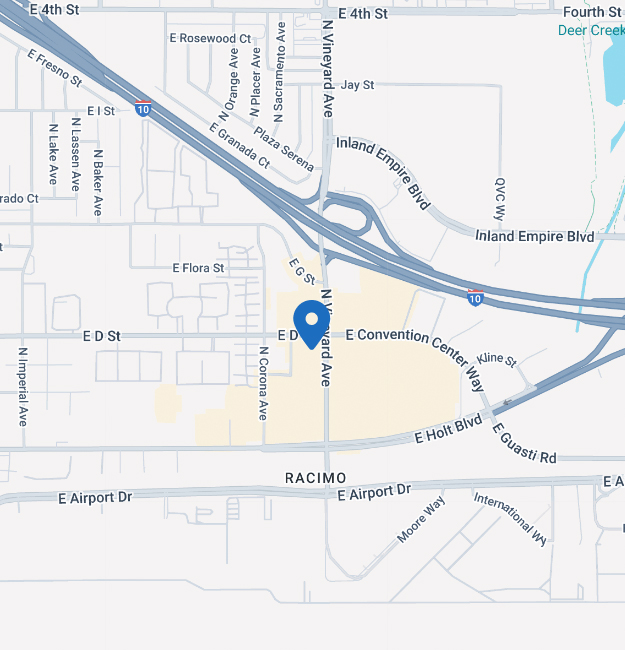
Shaw 3 Law Firm is conveniently located in the heart of Southern California, providing easy access for clients across the region. Our office is situated near major highways and public transportation, making it simple to visit us for your legal needs. We’re here to serve you!
Ontario, CA 91764


