Dedicated and
Passionate Law Firm
Providing Aggressive
Representation
Passionate Law Firm
Providing Aggressive
Representation





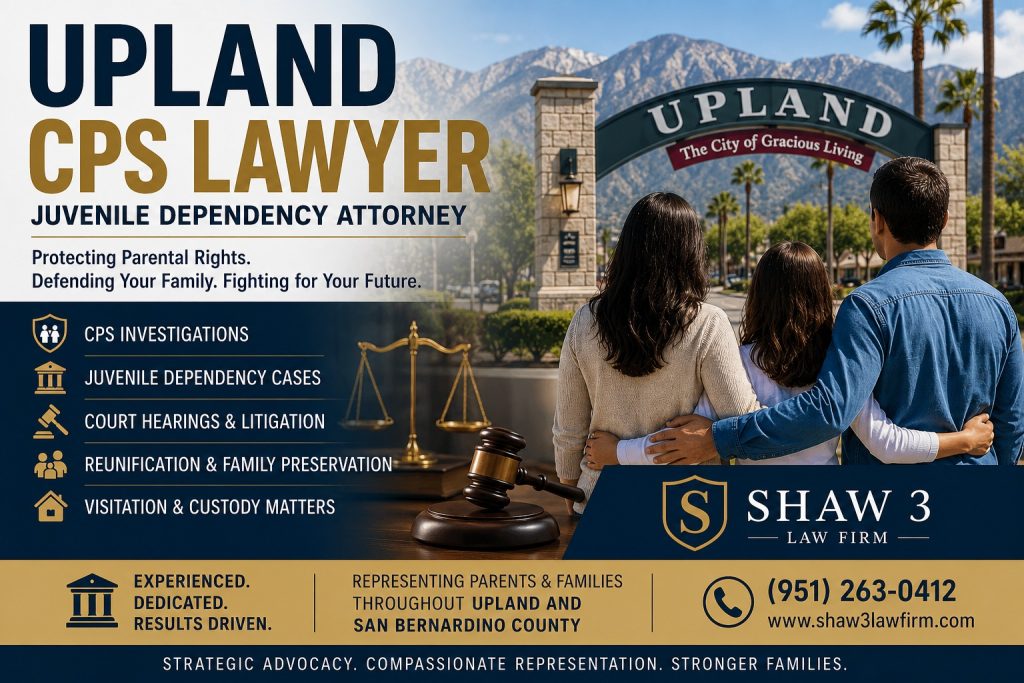
Child Protective Services (CPS) can turn a parent’s or guardian’s life upside down. If a social worker contacts you, someone reports you to CPS, or CPS threatens to remove your child from your home, act quickly to protect your parental rights by contacting an Upland CPS Lawyer | Juvenile Dependency Attorney.
Families in Upland typically work with San Bernardino County Children and Family Services (CFS), the agency that investigates allegations of child abuse, child neglect, domestic violence, substance abuse, mental health concerns, and other issues that may lead to a California Juvenile Dependency court case.
If CPS investigates you, contact an experienced Upland CPS Lawyer immediately to protect your rights. Consult a Juvenile Dependency Attorney before meeting CPS to protect your rights and avoid common legal mistakes. Early legal representation can often make a significant difference in how a CPS investigation or juvenile dependency case progresses.
At Shaw 3 Law Firm, we are committed to representing parents, legal guardians, and relatives throughout Upland and San Bernardino County in every stage of the California juvenile dependency process. Attorney Walter Shaw has successfully represented families in matters involving CPS investigations, emergency child removals, detention hearings, jurisdiction hearings, disposition hearings, family reunification, visitation disputes, relative placement, and Welfare and Institutions Code section 388 petitions. Every case receives a strategic and personalized approach focused on protecting the parent-child relationship and pursuing the best possible outcome.
If you face a CPS investigation or juvenile dependency case, contact Shaw 3 Law Firm’s experienced Upland CPS Lawyer today.
San Bernardino County CFS investigates reports of abuse, neglect, domestic violence, substance abuse, mental health, or failure to protect. Parents should take every CPS investigation seriously because it can affect custody, visitation, and lead to juvenile court intervention. Retaining an experienced Upland CPS Lawyer | Juvenile Dependency Attorney early in the process can help protect your legal rights, explain your options, and provide guidance before making statements or decisions that could impact your case.
In serious cases, CPS may determine a child faces immediate risk and remove the child from the home. Depending on the circumstances, the Department may remove a child with law enforcement assistance or juvenile court authorization. If CPS removes your child or threatens to remove your child, seek experienced legal representation immediately. An experienced Upland CPS Lawyer | Juvenile Dependency Attorney can evaluate the allegations, challenge unnecessary removals, and advocate for alternatives that allow children to remain safely with their families whenever permitted by law.
After an emergency removal, the court conducts a detention hearing to determine whether the child should remain in protective custody. This hearing allows parents to challenge the Department’s recommendations and seek their child’s safe return or less restrictive alternatives. Because important decisions are made early in the case, having an experienced Upland CPS Lawyer | Juvenile Dependency Attorney can significantly affect the direction of the dependency proceedings.
If the case continues, it proceeds through the California Juvenile Dependency Court, where the court determines whether the allegations are legally supported and what services, visitation orders, or placement decisions are appropriate. Shaw 3 Law Firm represents parents throughout Upland in CPS investigations and every stage of the juvenile dependency process. Our goal as Upland CPS Lawyer | Juvenile Dependency Attorney is to protect your parental rights, preserve your relationship with your child, and pursue the strongest possible outcome for your family.
In Upland, California, reports involving suspected child abuse or neglect are generally investigated by San Bernardino County Children and Family Services (CFS), the county agency responsible for protecting the safety and well-being of children. CFS serves as the local Child Protective Services (CPS) agency for families living in Upland and throughout San Bernardino County. The agency’s primary responsibility is to investigate reports of suspected child abuse, child neglect, abandonment, exploitation, or other circumstances that may place a child at risk of harm. While CFS is responsible for protecting children, it must also respect and balance the constitutional and legal rights of parents throughout the investigation and court process.
A CPS case often begins when San Bernardino County CFS receives a referral from a mandatory reporter, such as a teacher, physician, nurse, therapist, counselor, law enforcement officer, or another professional who suspects a child may be at risk. Reports may also be made by relatives, neighbors, or members of the public. After a referral, CFS may investigate. An experienced Upland CPS Lawyer helps you understand and navigate the process.
CPS investigates allegations of abuse, neglect, domestic violence, substance abuse, and other safety concerns, but not every report leads to court.
If San Bernardino County CFS believes a child is at substantial risk of harm, the Department may file a petition in California Juvenile Dependency Court requesting judicial oversight, protective orders, family reunification services, or, in some cases, the temporary removal of the child from the home. If you have been contacted by CPS in Upland, understanding your legal rights as early as possible is essential. An experienced Upland CPS Lawyer | Juvenile Dependency Attorney protects parental rights and provides strategic representation throughout the juvenile dependency process.
When someone reports a family in Upland, CPS reviews the referral to determine whether further investigation is necessary. Mandatory reporters—including teachers, doctors, nurses, therapists, law enforcement officers, and other professionals—must report suspected child abuse or neglect. Relatives, neighbors, and other members of the public may also submit CPS reports. A CPS referral does not mean the allegations are true or that CPS will remove your child.
If the referral meets the legal criteria for investigation, a CPS investigation will be opened. During the investigation, a social worker may conduct interviews with the parents, the child, relatives, teachers, medical providers, or anyone else who may have relevant information about the child’s safety and well-being. Social workers may request a home visit to assess living conditions, the child’s environment, and immediate safety concerns. Parents should consult an experienced Upland CPS Lawyer before making statements that could later become court evidence.
San Bernardino County CFS assesses whether a child faces an immediate or ongoing risk of harm during its investigation. The agency evaluates the allegations, family circumstances, and protective factors to determine whether the child can safely remain at home. The safety assessment determines whether CPS closes the case, offers voluntary services, or refers the matter to juvenile court.
A CPS investigation can have several possible outcomes. The referral may be determined to be unfounded or inconclusive and the case closed without further action. In other situations, San Bernardino County CFS may recommend voluntary services, implement a safety plan, or continue monitoring the family.If the Department determines a child cannot safely remain at home, it may remove the child and file a juvenile dependency petition. Hire an experienced Upland CPS Attorney early to protect your parental rights and pursue the best possible outcome.
One of the most common questions parents ask is whether Child Protective Services (CPS) can remove their child without warning. In Upland, California, San Bernardino County Children and Family Services (CFS) has the authority to seek an emergency child removal when it believes a child faces an immediate risk of serious harm. Emergency removals generally occur when delaying action could place the child’s health or safety at substantial risk. California law requires judicial oversight and important legal safeguards before or after removing a child.
After CPS removes a child, the agency places the child in protective custody until the juvenile court reviews the case.
Under California law, CPS may remove a child with a juvenile court warrant or, in emergencies, without a warrant to prevent serious harm. Whether a warrant is required depends on the specific facts and legal authority supporting the removal. If CPS removes a child, promptly consult an experienced Upland CPS Lawyer to protect your rights and challenge the removal.
California’s juvenile dependency laws do not allow the Department to remove a child simply because a parent could have made a better parenting decision or because someone has raised concerns about the family’s circumstances. Instead, the Department generally must prove that the child faces a substantial risk of serious physical harm or illness under Welfare and Institutions Code section 300. To keep a child out of a parent’s custody, the Department must also satisfy the legal standards set forth in Welfare and Institutions Code section 319 at the detention stage and section 361, subdivision (c) at disposition. Whether the Department meets these legal standards depends on the specific facts and evidence presented in each case. An experienced Juvenile Dependency Attorney challenges allegations and protects parental rights while pursuing your child’s safe return.
If Child Protective Services (CPS) removes a child in Upland, the juvenile court typically holds a detention hearing as the first court hearing in the case. At the detention hearing, the court decides whether the child should remain in protective custody or safely return to a parent while the juvenile dependency case proceeds.Having an experienced Upland CPS Lawyer at this hearing can be critical to protecting your parental rights.
The jurisdiction hearing determines whether San Bernardino County Children and Family Services (CFS) has presented sufficient evidence to support the allegations contained in the dependency petition under Welfare and Institutions Code section 300. If the allegations are sustained, the court will assume jurisdiction over the child.
At the disposition hearing, the court decides whether the child should remain in the home or be placed elsewhere while the case continues. The court may order reunification services, visitation, counseling, parenting classes, substance abuse treatment, or other appropriate services.
During the six-month review hearing, the juvenile court evaluates the parent’s progress with the court-ordered case plan. The court considers continuing reunification services, expanding visitation, or ordering additional services to support a safe return home.
At the twelve-month review hearing, the court evaluates reunification progress, child safety, and whether permanency should be considered.
The eighteen-month review hearing is generally the final opportunity for reunification services. The court determines whether the child can safely return home or whether the case should proceed toward permanency.
At a section 366.26 hearing, the court selects adoption, guardianship, or another permanent plan for the child.
If the court concludes that adoption is in the child’s best interests, it may order the termination of parental rights. Parents facing CPS cases should promptly consult an experienced Upland Juvenile Dependency Attorney to protect their rights.
In Upland, San Bernardino County Children and Family Services (CFS) may investigate allegations of physical abuse when it believes a child has suffered, or is at substantial risk of suffering, serious physical harm inflicted non-accidentally by a parent or caregiver. These cases are generally brought under Welfare and Institutions Code section 300(a).
Allegations of child neglect often involve inadequate supervision, unsafe living conditions, medical neglect, educational neglect, or a parent’s inability to provide regular care. Neglect cases are commonly filed under Welfare and Institutions Code section 300(b)(1) when CFS believes a child’s health or safety is at substantial risk.
Exposure to domestic violence may result in a CPS investigation if the Department believes the violence places a child at substantial risk of serious physical harm. These allegations are frequently alleged under Welfare and Institutions Code section 300(b)(1) and are evaluated based on the specific facts of each case.
A parent’s drug use does not automatically justify court intervention. However, if illegal drug use or substance abuse creates a substantial risk to a child’s safety or well-being, San Bernardino County CFS may seek juvenile court involvement under section 300(b)(1).
Similarly, alcohol abuse becomes a dependency issue when it allegedly affects a parent’s ability to safely supervise or care for a child. These allegations are also commonly filed under section 300(b)(1).
A parent experiencing mental health challenges is not, by itself, grounds for a dependency case. The Department generally must show that the condition creates a substantial risk of harm to the child before proceeding under section 300(b)(1).
Failure to protect allegations typically arise when CPS claims a parent knew or reasonably should have known of a danger to the child but failed to take reasonable protective action. These allegations are commonly pursued under section 300(b)(1).
The Department generally files sexual abuse allegations under Welfare and Institutions Code section 300(d) when it alleges that a child has suffered sexual abuse or faces a substantial risk of sexual abuse. Because these cases involve some of the most serious allegations in California Juvenile Dependency Court, parents should seek immediate legal representation from an experienced Upland CPS Lawyer.
Family reunification is one of the primary goals of the California juvenile dependency system. After CPS removes a child, the juvenile court may order reunification services based on the family’s circumstances and allegations.
A case plan outlines required services, including counseling, parenting, treatment, and other programs supporting family reunification. Successfully completing the case plan can play an important role in demonstrating progress to the juvenile court.
Juvenile courts often order counseling, therapy, and parenting classes to address concerns and support family reunification. When deciding whether to reunify a family, the court often considers a parent’s consistent participation and meaningful progress.
Maintaining regular visitation is another important component of family reunification. Depending on the circumstances of the case, visits may begin as supervised and later progress to unsupervised visits, extended visits, overnight visitation, or ultimately the return of the child to the parent’s custody. The juvenile court reviews a parent’s progress throughout the dependency case when deciding whether to liberalize visitation.
Shaw 3 Law Firm protects parental rights, seeks reunification, and advocates for expanded visitation throughout Upland and San Bernardino County.
When Child Protective Services (CPS) removes a child from a parent’s custody in Upland, California, the juvenile court and San Bernardino County Children and Family Services (CFS) may place the child with a suitable family member or another qualified caregiver instead of placing the child in traditional foster care. California law may favor placement with established caregivers to preserve family connections, stability, and the child’s emotional well-being.
Grandparents are often among the first relatives considered for placement. Under Welfare and Institutions Code section 361.3, grandparents may receive preferential consideration when requesting placement, provided the placement is in the child’s best interests and the home satisfies applicable safety and approval requirements. The court considers numerous factors, including the child’s relationship with the grandparent, the ability to provide a safe and stable home, and the willingness to support family reunification when appropriate.
California law also allows other relatives, including adult siblings, aunts, uncles, cousins, and other qualifying family members, to request placement of a child involved in a dependency case. San Bernardino County CFS evaluates each proposed placement by considering the child’s safety, the caregiver’s ability to meet the child’s needs, and the statutory factors set forth in Welfare and Institutions Code section 361.3.
In appropriate cases, the juvenile court may place a child with a Non-Relative Extended Family Member (NREFM)—an adult who has an established familial or mentoring relationship with the child, even though the individual is not related by blood or marriage. California law permits NREFM placements when the caregiver satisfies the required approval process and the placement serves the child’s best interests.
Although relatives and NREFMs may receive statutory consideration for placement, placement is not automatic. The juvenile court ultimately determines whether the requested placement is appropriate based on the child’s best interests and the evidence presented.Shaw 3 Law Firm represents parents, relatives, and caregivers, protecting family rights in Upland juvenile dependency proceedings.
Maintaining meaningful contact between parents and their children is an important part of the California juvenile dependency process. In Upland, the juvenile court determines the type and frequency of visitation based on the child’s safety, the parent’s progress, and the recommendations of San Bernardino County Children and Family Services (CFS). The court’s goal is to preserve and strengthen the parent-child relationship while ensuring that visits occur in a safe and appropriate environment.
In many Upland CPS cases, visitation begins as monitored visitation, also referred to as supervised visitation. During these visits, another approved adult or agency monitor is present to observe the interaction between the parent and child.The juvenile court commonly orders monitored visitation when it determines that a parent needs supervision while participating in court-ordered services or while addressing the allegations in the juvenile dependency case.
As parents demonstrate progress by complying with their case plan, participating in services, and addressing the issues that brought the family before the juvenile court, the court may authorize unmonitored visitation. These visits allow parents to spend time with their children without a monitor present, providing greater opportunities to rebuild trust, strengthen family relationships, and demonstrate their ability to safely care for their children.
When reunification continues to progress successfully, the juvenile court may approve overnight visitation. Overnight visits help courts evaluate reunification by considering the child’s best interests, parental progress, and overall case circumstances.
Parents may request expanded visitation throughout a dependency case as their circumstances improve. Liberalization may include longer visits, unsupervised visitation, weekend visits, overnight visitation, or other increased contact. Shaw 3 Law Firm advocates for visitation and expanded parenting time for parents throughout Upland and San Bernardino County.
Choosing the right attorney can make a significant difference when facing a Child Protective Services (CPS) investigation or California juvenile dependency case. At Shaw 3 Law Firm, we represent parents, legal guardians, relatives, and caregivers involved in San Bernardino County CPS matters, including families in Upland, California. Rather than dividing our attention among many practice areas, we have developed substantial experience handling CPS investigations, emergency child removals, detention hearings, jurisdiction and disposition hearings, review hearings, relative placement disputes, visitation issues, and Welfare and Institutions Code section 388 petitions.
Attorney Walter Shaw has secured favorable CPS outcomes, including child returns, unsupervised visitation, reunification, and relative placement throughout California.
Every CPS case begins with a carefully developed legal strategy. Shaw 3 Law Firm explains the dependency process, prepares clients, and protects parental rights through every stage of the case.
When litigation becomes necessary, Walter Shaw provides strong courtroom advocacy on behalf of parents and families in juvenile dependency court. Shaw 3 Law Firm protects parental rights through every CPS case with experienced, strategic representation for families throughout Upland and San Bernardino County.
If San Bernardino County Children and Family Services (CFS) contacts you, remain calm and understand your legal rights before making any statements. Speaking with an experienced Upland CPS Lawyer early can help you navigate the investigation and protect your parental rights.
In emergencies, CPS may remove a child without a court order, but the juvenile court promptly reviews the removal.
Generally, CPS needs consent, a court order, or a legal exception to enter your home. Consult a Juvenile Dependency Attorney.
Depending on the circumstances, California law permits CPS to interview children during an investigation, including at school in certain situations. An experienced attorney can explain how these interviews may affect your case.
After investigating, San Bernardino County CFS may close the case, offer services, implement a safety plan, or file a petition.
Every dependency case is unique. Some CPS investigations end within weeks, while juvenile dependency cases may last several months or longer.
Marijuana use alone does not justify removal; the Department generally must prove a substantial risk to the child’s safety.
Yes. Grandparents, relatives, and certain Non-Relative Extended Family Members (NREFMs) may request placement during a dependency case. The juvenile court considers the child’s best interests and Welfare and Institutions Code section 361.3 placement factors.
The juvenile court usually holds a detention hearing as the first court hearing after CPS removes a child. At the hearing, the court decides whether the child should remain in protective custody or return home.
During the jurisdiction hearing, the juvenile court decides whether the Department proved the allegations in the dependency petition. If the court sustains the allegations, it proceeds to the disposition hearing.
Yes. As parents complete court-ordered services and demonstrate progress, the juvenile court may expand visitation and ultimately reunify the family.
A Welfare and Institutions Code section 388 Petition requests modification of prior juvenile court orders, including visitation, reunification, or child return.
Retain an experienced Upland CPS Lawyer early to protect your rights, challenge allegations, and guide you through the dependency process.
Whether you’re in San Bernardino, Ontario, Victorville, Rancho Cucamonga, Montclair, Chino, Chino Hills, Fontana, Rialto, Colton, Highland, Redlands, Loma Linda, Grand Terrace, Yucaipa, Hesperia, Apple Valley, Adelanto, Barstow, Needles, Big Bear, Twentynine Palms, Joshua Tree, Yucca Valley or anywhere in San Bernardino County, or Riverside County, Los Angeles County, Orange County or any other county in California, we’re here to help.
Contact Walter Shaw today for a confidential consultation with an experienced Upland CPS Lawyer and Juvenile Dependency Attorney.
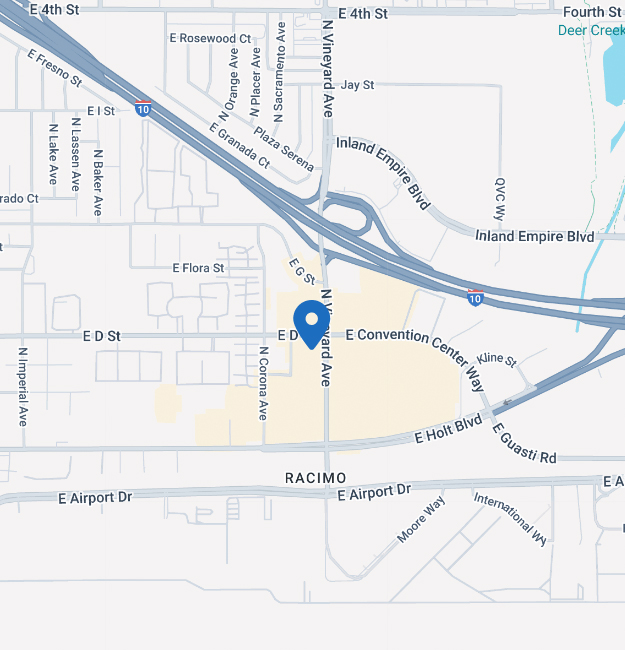
Shaw 3 Law Firm is conveniently located in the heart of Southern California, providing easy access for clients across the region. Our office is situated near major highways and public transportation, making it simple to visit us for your legal needs. We’re here to serve you!
Ontario, CA 91764


